
Yet, most people know the word AI. Very few people understand these five terms. Yet these terms control how every AI tool behaves.
Tech experts throw these words around constantly. They rarely stop to explain what they mean. This guide fixes that problem. Each term gets a plain-English explanation. Each one also gets a real example that makes it click.
Tokenization Breaks Your Text Into Pieces
AI models don’t read whole sentences the way you do. They break your text into small chunks called tokens first. This happens before any actual thinking starts.
A token isn’t always a full word. The word “unbelievable” might split into three tokens. Short words like “the” usually become one token each. This detail matters more than you’d guess.
Every AI tool has a limit on tokens. Every response you get also uses up tokens. You’ve probably heard the term “context window.” That’s just a fancy way of describing token memory. It’s how much an AI can hold during your conversation.
OpenAI’s tokenizer tool shows this in action. Paste any text in, and you’ll see it split into tokens instantly. Try it once, and the concept clicks fast.
Long, complex words eat up more tokens than short ones. This explains why huge documents sometimes get summarized. There’s a hard limit on how much fits at once.
Fine-Tuning Turns a Generalist Into a Specialist
Fine-tuning takes an AI model that already knows a lot. It then trains that model on a narrower dataset. The goal is simple. Make the model excellent at one job.
Picture a general doctor who later studies cardiology. The doctor already understands medicine broadly. The extra training just sharpens one specific skill.
Businesses use fine-tuning constantly. A law firm might fine-tune a model on old contracts. The result gets sharper at spotting unusual clauses. A generic AI model would likely miss those same details.
This process isn’t something casual users do themselves. It requires real technical skill. It also needs solid training data. Google Cloud explains the technical side in more depth.
Fine-tuning isn’t always the right fix, though. Sometimes a business just needs current information. A different approach usually works better in that case.
RAG Lets AI Look Things Up First
That better approach is called Retrieval-Augmented Generation, or RAG. The name sounds complicated. The idea behind it isn’t.
RAG means an AI checks an outside source first. It looks for real information before answering you. Instead of relying only on old training data, it searches first. Then it responds using what it found.
Here’s why this matters. Every AI model has a training cutoff date. It can’t know about last week’s news on its own. RAG solves that gap directly.
This is exactly how AI assistants discuss breaking news. It’s also how they reference a document you just uploaded. The system retrieves real, current material first. Then it builds its answer around that information.
Businesses love RAG for a good reason. A company can connect an AI tool to its own documents. The AI can then answer specific company questions accurately. Nobody needs to retrain the entire model. IBM breaks this down further for anyone curious.
RAG also tends to show its sources. That transparency makes answers easier to double-check.
Temperature Controls Creativity
Temperature is a setting that shapes AI responses. It decides how predictable or random an answer feels. It’s usually a number between 0 and 2.
A low temperature keeps things safe. The AI picks the most obvious word almost every time. Answers come out focused and consistent. This works great for code or fact-based summaries.
A high temperature does the opposite. The AI takes more risks with word choice. Responses feel more creative, sometimes surprising. This suits brainstorming or creative writing far better.
Ask an AI at low temperature to write something five times. You’ll get five nearly identical answers. Crank the temperature up, and those answers start looking genuinely different.
Most everyday chat tools set a balanced temperature automatically. Developers building their own tools can adjust it directly. It depends on what feeling they want their product to have.
Over-fitting Means Memorizing Instead of Learning
Over-fitting happens when an AI studies its training data too closely. It starts memorizing exact examples instead of learning general patterns. Those patterns are supposed to apply to new situations.
Think of a student who memorizes every practice question. They do it word-for-word, without understanding the actual concept. That student aces the practice test easily. Then the real exam asks something slightly different. Suddenly everything falls apart for them.
An over-fit AI model behaves exactly the same way. It performs brilliantly on its own training data. It stumbles badly on new, unfamiliar situations. This counts as a real flaw. AI is supposed to generalize, not just memorize.
Here’s a concrete example to picture. Imagine an image model trained only on daylight cat photos. That model might fail to recognize a cat in a dim room. Any person could spot that cat instantly. The model memorized lighting patterns instead of learning what cats actually look like.
Developers fight over-fitting by testing models on unfamiliar data. They also limit how much a model adjusts per example. AWS offers a clear technical breakdown of this concept.
Spotting These Terms in the Real World
Once you know these five words, you’ll start noticing them. They show up everywhere in AI marketing language.
A chat-bot that “searches the web” is using RAG. A writing tool with “precise” versus “creative” modes is adjusting temperature. A customer service bot that seems oddly expert on one company was probably fine-tuned on that company’s documents.
Even token limits show up constantly in everyday use. Ever see a message saying a document is “too long to process”? That’s tokenization hitting its ceiling.
These patterns turn confusing marketing language into something decodable. You can actually understand claims instead of just accepting them.
The Five Terms Working Together
None of these ideas exist in isolation. They connect directly to how well an AI tool performs.
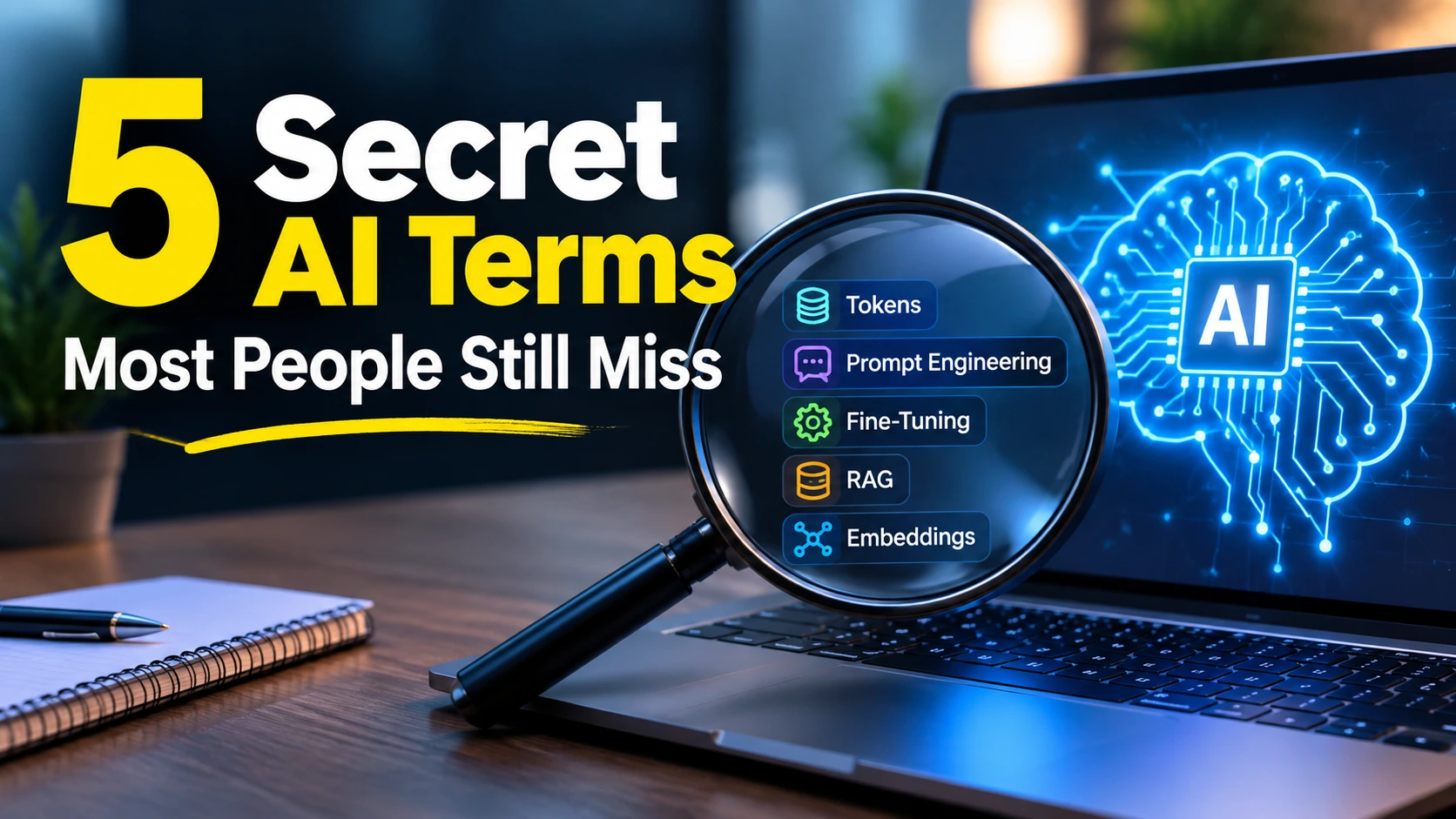
Tokenization limits how much fits into one conversation. Fine-tuning determines a model’s specialty. RAG decides whether an AI can access fresh information. Temperature shapes creativity versus consistency. Over-fitting explains why some models fail outside their training data.
Together, these five ideas explain a lot. They cover most of the real difference between AI tools. Some tools feel genuinely useful. Others simply fall flat.
Editor’s Note
Understanding these five terms won’t make you a machine learning engineer. It will make you harder to impress with vague AI marketing claims. Next time a company promises their AI is “smarter,” you’ll know exactly which mechanic they mean. That’s a real edge most people never bother to build.
We aim to provide accurate, reliable, and current information. Since AI terminology and technology continue to evolve, some details in this guide may shift over time. If you spot an error in this article, please contact us at support@digieh.com or read our Corrections Policy and we’ll correct it as soon as possible.