
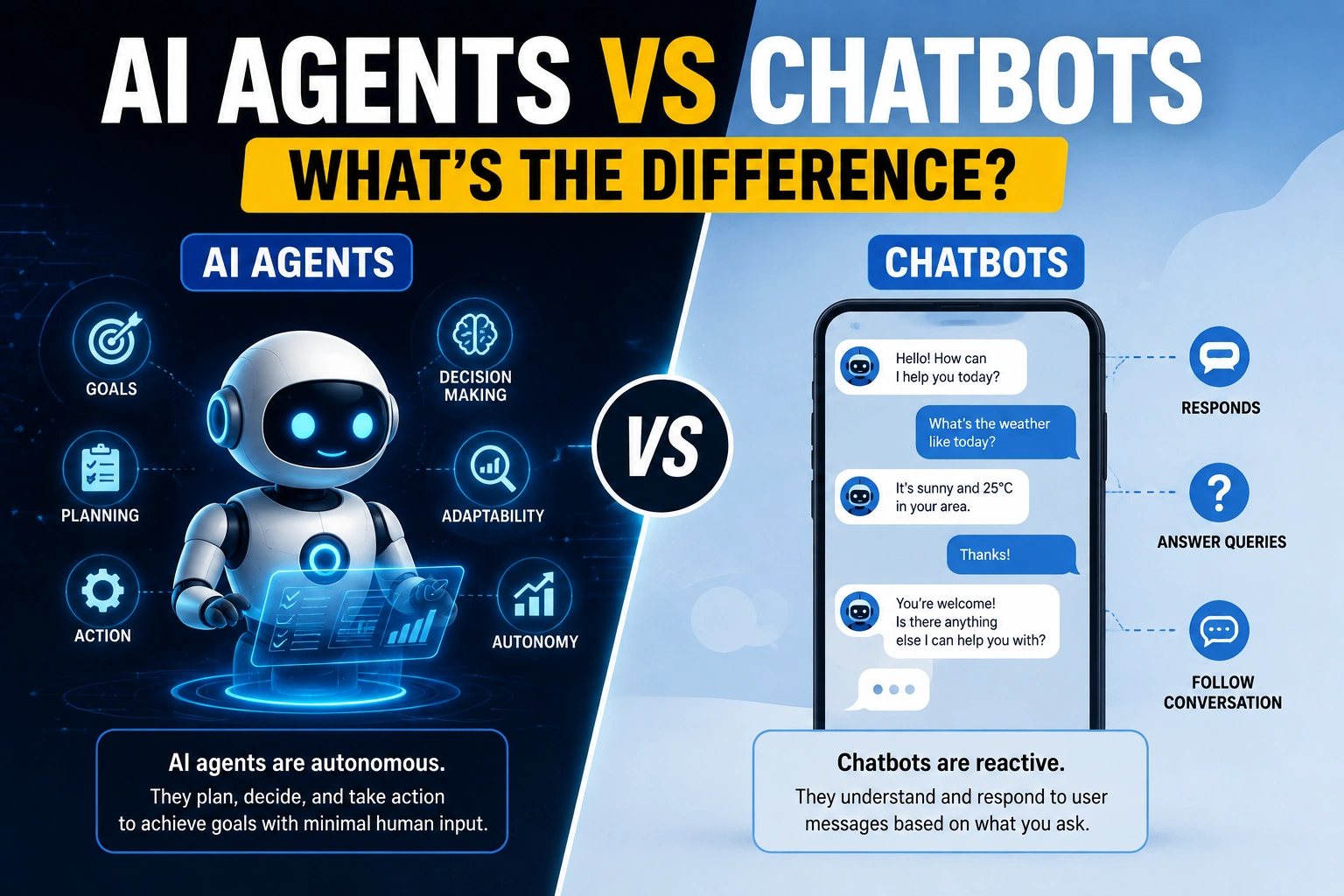
AI agents and chatbots may sound similar, but they work very differently. Here’s a simple breakdown of what sets them apart.
Both terms get thrown around a lot these days, often used interchangeably in marketing materials and tech articles. However, treating them as the same thing can lead to confusion, especially if you’re trying to choose the right tool for a task. Let’s break down exactly how these two types of AI differ, and when each one actually makes sense.
What Is a Chatbot?
A chatbot is a piece of software designed to hold a conversation with you. Most chatbots work by matching your question to a pre-written answer, often pulled from an FAQ page or a simple knowledge base.
Traditional chatbots rely on basic technology like keyword recognition and decision trees. If you type a specific phrase, the chatbot responds with a matching, pre-programmed answer. When your question falls outside its script, though, things fall apart quickly. You’ll often see a generic response like “I didn’t understand that” or get redirected to a human agent.
Newer chatbots have improved significantly by adding large language models (LLMs), the same underlying technology that powers tools like ChatGPT. These AI-powered chatbots understand natural language much better than older rule-based systems. Even so, they still typically operate in a simple request-response pattern. You ask a question, the chatbot processes it, and it gives you an answer. There’s no ongoing reasoning process behind the scenes.
Chatbots work well for simple, repetitive, low-risk tasks. Think of things like checking store hours, resetting a password, or answering basic pricing questions.
What Is an AI Agent?
An AI agent takes things several steps further. Rather than just answering a question, it can actually complete a task from start to finish, often without needing a human to guide it through every step.
At its core, an AI agent is also built around a large language model, similar to those used by Anthropic’s Claude or Google’s Gemini. However, unlike a basic chatbot, an agent operates inside what’s often called a reasoning loop. It observes a situation, reasons about what needs to happen, takes an action, and then evaluates whether the goal has been achieved. If not, it adjusts and tries again.
This ability to plan, take real action, and adjust along the way is what truly separates an agent from a chatbot. IBM’s overview of AI agents breaks this architecture down in more technical detail, if you’d like to dig deeper.
A Real-World Example: IT Support Requests
Here’s a simple example that shows the difference clearly. Imagine an employee can’t log into an important work application.
With a basic chatbot, the employee would type out the problem and receive a scripted response, something like a link to a general troubleshooting guide. If that doesn’t solve the issue, the chatbot has reached its limit, and a human support agent has to step in to handle the rest.
An AI agent handles the same situation very differently. It checks the employee’s account permissions directly. If access should be allowed, it grants it automatically. If approval is needed first, it sends the request straight to the employee’s manager. Once approved, the agent updates the support ticket, notifies the employee that the issue is resolved, and even adds a short summary to the company’s internal knowledge base for future reference.
Notice the difference. The chatbot pointed the employee toward a possible answer. The agent actually solved the problem, start to finish, without anyone needing to intervene.
The Core Differences, Explained Simply
While there are several technical details involved, the differences between chatbots and AI agents really come down to a few key areas.
Autonomy
Chatbots wait for instructions and respond one message at a time. AI agents can work toward a goal on their own, often completing several steps without needing constant human input.
Memory
Most chatbots have little to no memory. Each conversation often starts fresh, which is why you might find yourself repeating information you already provided. AI agents, on the other hand, can hold onto both short-term context from the current conversation and long-term memory from past interactions.
Reasoning
A chatbot matches your input to the closest available response. An AI agent actually reasons through a problem, breaking it into smaller steps and deciding what action makes sense next.
Taking Action
This might be the biggest difference of all. Chatbots generate text. AI agents can take real action, whether that means updating a database, sending an email, or completing a transaction inside another system.
Learning Over Time
Basic chatbots don’t improve on their own. Someone has to manually update their scripts. Many AI agents, however, can learn from past interactions and gradually get better at handling similar situations in the future.
Why This Confusion Happens So Often
If you’ve noticed companies calling almost everything an “AI agent” lately, you’re not imagining it. This trend even has a name in the industry: agent-washing.
This happens when a company takes a basic chatbot, adds a more natural-sounding conversational layer, and markets it as a full AI agent, even though it can’t actually take independent action or complete multi-step tasks. According to Gartner’s research on enterprise AI adoption, only a small fraction of products marketed as “AI agents” actually meet the technical bar for true agentic behavior.
Because of this, it’s worth asking specific questions before trusting a vendor’s claims. Can this system actually complete a task without a human finishing it? Does it remember previous interactions? Can it make decisions across multiple steps, or does it just answer one question at a time?
When Should You Use a Chatbot Instead of an AI Agent?
Despite all the hype around AI agents, chatbots aren’t going away anytime soon, and that’s actually a good thing. For certain tasks, a chatbot is genuinely the better choice.
If a task is simple, repetitive, and doesn’t require much context, a chatbot handles it efficiently and affordably. Good examples include answering frequently asked questions, providing store hours, or walking someone through a basic form. Building or running a full AI agent for tasks like these would add unnecessary cost and complexity.
AI agents make more sense when a task spans multiple systems, requires follow-up steps, or depends heavily on context that changes from one interaction to the next. Automating an entire onboarding process for a new employee, for example, involves multiple steps and systems working together, which plays directly to an agent’s strengths.
Many businesses are now adopting a hybrid approach. They use chatbots to handle high-volume, simple requests, while reserving AI agents for more complex, high-value tasks that genuinely benefit from autonomous decision-making.
Editor’s Note
The terms “chatbot” and “AI agent” get used so loosely these days that it’s easy to lose track of what actually matters, what a system can genuinely do for you. Instead of getting caught up in labels, it helps to ask a simple question. Does this tool just answer questions, or can it actually get something done on its own? That one distinction will tell you more than any marketing page ever will.
We aim to provide accurate, reliable, and current information. Since AI technology changes quickly, terms and capabilities in this space may evolve over time. If you spot an error in this article, please contact us at support@digieh.com or read our Corrections Policy and we’ll correct it as soon as possible.