TRENDING
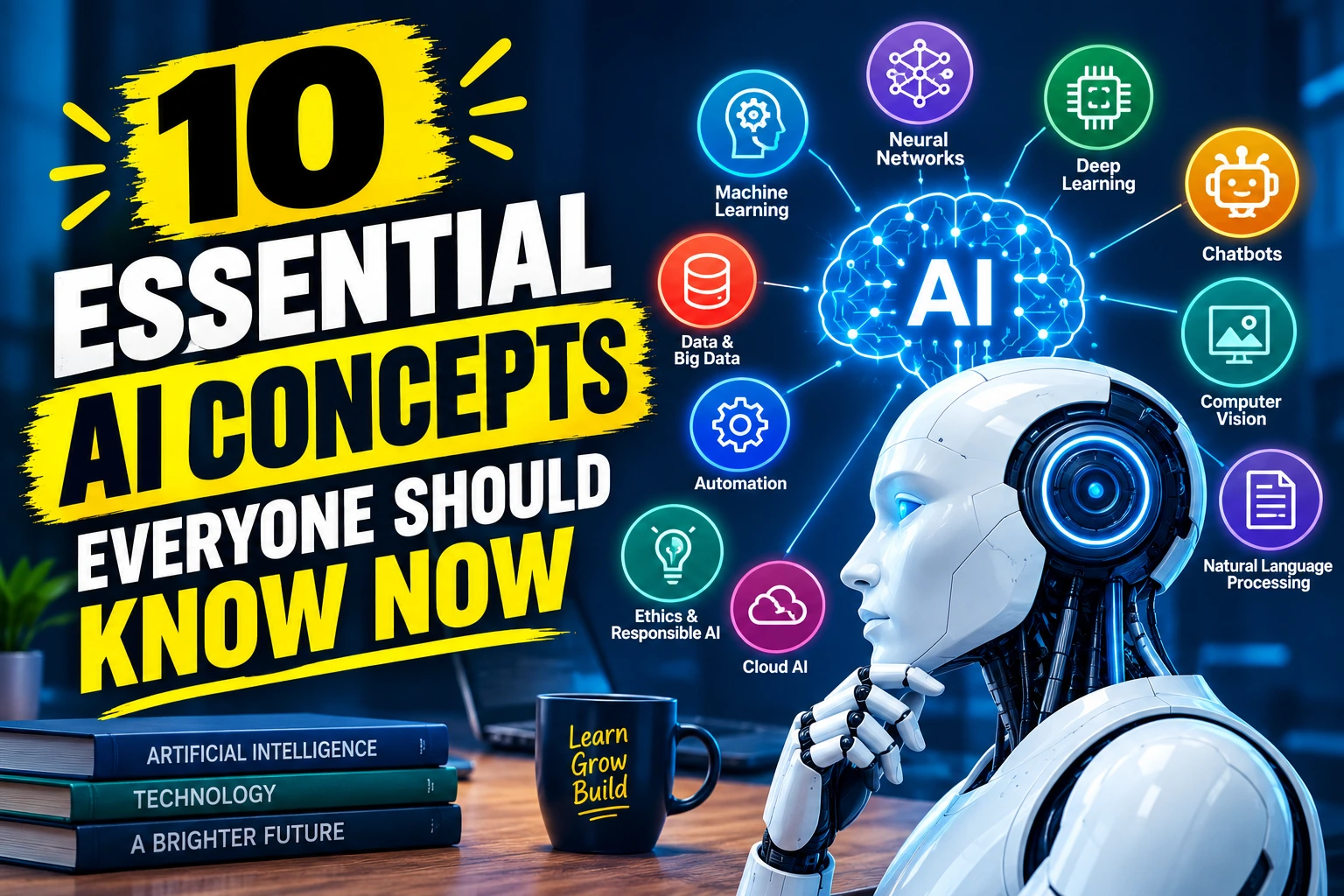
10 Essential AI Concepts Everyone Should Know Now

10 min read
Last updated November 8, 2026
Artificial intelligence now shows up in phones, search engines, cars and office software. Yet many people still feel unsure what the basic ideas actually mean.
You do not need a technical degree to understand the core concepts. A few clear explanations make news stories and product claims much easier to follow.
This guide covers 10 essential concepts in plain English. Each one includes a simple example you can remember.
Key Takeaways
- Artificial intelligence is the broad field, and machine learning sits inside it.
- Deep learning uses layered neural networks to handle complex tasks.
- Large language models power most of today’s chatbots.
- Training data shapes what a system knows and how fair it is.
- Bias and explainability are key questions for trustworthy tools.
4+ layersDeep learning generally means neural networks with at least four layers, according to IBM.
1. Artificial Intelligence
Artificial intelligence is the broad field of making computers do tasks that usually need human thinking. IBM describes it as getting computers to reason and make decisions in ways that resemble human thinking.
Examples include recognizing faces, translating languages and recommending movies. Each task once required a person.
Think of artificial intelligence as the big umbrella. Every other concept on this list sits underneath it.
2. Machine Learning
Machine learning is a branch of artificial intelligence where systems learn from data instead of following only fixed rules. IBM explains that these systems improve by learning from data.
A spam filter is a classic example. It studies many emails marked as spam and learns patterns that predict junk mail.
The more good examples it sees, the better it usually gets. That is the core idea of learning from data.
Which concept was hardest to understand before today?
- Machine learning
- Neural networks
- Large language models
- Not sure
3. Neural Networks
A neural network is a pattern-finding system loosely inspired by the human brain. It is made of connected units, often called nodes or neurons.
IBM explains that each network has an input layer, hidden layers and an output layer. Connections between nodes carry adjustable weights that change during training.
Picture a team passing notes down a line. Each person adjusts the message slightly until the final person gives an answer.
4. Deep Learning
Deep learning is a type of machine learning that uses neural networks with many layers. IBM says it underpins much of today’s leading technology, including image recognition and self-driving cars.
Early layers spot simple patterns, such as edges in a photo. Deeper layers combine them into complex shapes, such as faces.
Deep learning usually needs very large amounts of data and computing power. That is why it grew quickly as computers became faster.
Good to know. All deep learning is machine learning, and all machine learning is artificial intelligence, but not the other way around.
5. Large Language Models
Large language models are deep learning systems trained on huge amounts of text. They predict which words should come next in a sentence.
That simple skill lets them write emails, summarize reports and answer questions. Most popular chatbots run on these models.
IBM notes that a design called the transformer powers most large language models and chatbots. It helps the model pay attention to the most relevant words.
6. Generative Artificial Intelligence
Generative tools create new content, such as text, images, music or video. They learn patterns from existing examples and produce something new.
Image generators turn a short description into a picture. Writing assistants turn bullet points into paragraphs.
These tools are powerful but can also produce errors or misleading content. Always review what they create before you share it.
- Artificial intelligence is the umbrella
- Machine learning learns from data
- Neural networks find patterns
- Deep learning uses many layers
- Large language models write text
- Check outputs for bias and errors
7. Training Data
Training data is the information a system learns from. It can include text, images, sounds or numbers.
Quality matters as much as quantity. Outdated, incomplete or unbalanced data leads to weak or unfair results.
A model trained mostly on one type of example may struggle with others. That is why diverse, accurate data is so important.
8. Prompts
A prompt is the instruction you give a tool. Clear prompts usually produce better answers.
Tell the tool who the audience is, what format you want and how long the answer should be. Give an example when you can.
If the first answer misses the mark, refine your prompt step by step. Small changes often make a big difference.
Quick tip. Start prompts with the audience and format you want, such as “Explain to a 10-year-old in five bullet points.”
9. Bias
Bias happens when a system produces unfair results for certain groups. It often comes from unbalanced training data or flawed design.
The United States National Institute of Standards and Technology released a risk framework in January 2023. A summary from the law firm Davis Wright Tremaine explains its approach. It lists fairness, with harmful bias managed, as a key trait of trustworthy tools.
The same summary notes three kinds of bias, which are systemic, computational and statistical, and human-cognitive. Tools can even amplify human biases if no one checks them.
10. Explainability
Explainability means understanding how a system reached its answer. Some models are easy to explain, while others act like black boxes.
IBM notes that deep learning models are often called black boxes because their inner workings are hard to interpret. That makes it tricky to know why they make certain choices.
Explainability matters most in areas like loans, hiring and health. People deserve to know why a decision affects them.
Which concept sits inside machine learning?
- Artificial intelligence
- Deep learning
- The internet
Deep learning is a type of machine learning, which itself is part of artificial intelligence.
How These Concepts Fit Together
The ideas on this list stack like nesting boxes. Artificial intelligence is the biggest box, with machine learning inside it.
Deep learning sits inside machine learning and relies on neural networks. Large language models are one powerful use of deep learning.
Training data feeds all of them, while bias and explainability help judge whether they are trustworthy. Prompts are how everyday users steer them.
More Terms to Explore
Once you know these basics, a few more terms are worth learning. Tokens, fine-tuning, retrieval and temperature come up often.
Our guide to 5 secret artificial intelligence terms most people still miss explains them simply.
You can also read our explainer on agents versus chatbots to understand two common tool types.
What often causes bias in these systems?
- Unbalanced training data
- Fast internet
- Large screens
When training data underrepresents some groups, results can be unfair to them.
The Seven Traits of Trustworthy Tools
The same risk framework lists seven traits that make these systems trustworthy. According to the Davis Wright Tremaine summary, they include being valid and reliable, safe, and secure.
The list also includes accountability, transparency, explainability, privacy protection and fairness. Together they give a simple checklist for judging any tool.
When you compare products, ask how each one handles these traits. Clear answers point to a more responsible company.
Free updates
Join the Digieh list
Be the first to know when our weekly brief launches.
No spam. Unsubscribe anytime. Read our Privacy Policy.
A Short History of the Field
The idea of thinking machines goes back decades. Early researchers built programs that followed long lists of hand-written rules.
Machine learning grew popular as computers became faster and data more plentiful. Instead of writing every rule, people let systems learn from examples.
Deep learning took off in the 2010s, helped by powerful graphics chips. Large language models and chatbots then brought the field into everyday life.
Where You Already Meet These Ideas
These concepts power many everyday tools. Your phone uses machine learning to sort photos and suggest words as you type.
Streaming services use it to recommend shows. Banks use it to spot unusual card activity.
Map apps predict traffic using patterns from past trips. Once you notice them, these systems are everywhere.
Concepts for Parents and Teachers
Children meet these tools early, at school and at home. A few simple explanations help them use the tools safely.
Explain that machine learning means a computer learned from many examples, like a student practicing. Remind kids that tools can make mistakes and should be checked.
Teachers can turn concepts into games, such as sorting pictures to show how training data works. Hands-on activities make abstract ideas stick.
Our guide on how to set up parental controls helps families manage tool use on shared devices.
Concepts in Health and Money
These systems increasingly help doctors read scans and help banks flag fraud. They can speed up decisions and catch patterns people miss.
Because the stakes are high, explainability and bias matter most here. A wrong or unfair result can affect someone’s health or finances.
Always talk with a qualified professional about important health or money decisions. Use these tools as a starting point, not the final word.
Common Myths
Many people think these systems truly understand like humans. In reality, they find patterns in data without human awareness or feelings.
Another myth says more data always fixes problems. Poor-quality data can make results worse, not better.
Some believe these tools are always objective. Bias in data or design can lead to unfair outcomes.
Questions to Ask About Any New Tool
These concepts help you ask sharper questions before trying a new product. Ask what data the tool was trained on and how often it is updated.
Ask how the company checks for bias and errors. Find out whether it explains its answers or shows sources.
Clear, honest answers are a good sign. Vague promises deserve extra caution.
How to Keep Learning
You can build on these basics with short, regular practice. Read one explainer a week and try one new tool feature.
Free online courses from universities and libraries cover these topics at a beginner level. Many include short videos and quizzes.
Explaining a concept to a friend is a great test. If you can say it simply, you truly understand it.
Using These Tools Responsibly
Understanding the basics helps you use tools wisely. Check important facts, especially for health, legal and money questions.
Protect your privacy by avoiding sensitive details in prompts. Read each tool’s privacy settings before you sign up.
Our list of free artificial intelligence tools that save hours weekly is a good place to practice safely.
Why This Knowledge Matters at Work
Many jobs now involve these tools in some way. Knowing the vocabulary helps you join conversations and ask smart questions.
It also helps you spot hype in sales pitches. Our guide on whether artificial intelligence will take your job explores how work is changing.
Try this today. Pick one app on your phone and guess which concept it uses, such as machine learning for photo sorting.
Frequently Asked Questions
What is the difference between artificial intelligence and machine learning?
Artificial intelligence is the broad field, while machine learning is one approach within it that learns from data.
What is deep learning?
Deep learning is a type of machine learning that uses neural networks with many layers to handle complex tasks.
What is a large language model?
It is a deep learning system trained on large amounts of text to predict and generate words.
Why does bias happen?
Bias often comes from unbalanced training data or flawed design choices.
What does explainability mean?
It means understanding how a system reached its answer, which matters for decisions that affect people.
Conclusion
These 10 concepts explain the foundation of modern artificial intelligence. Once you know them, news and product claims become much clearer.
Start with the big picture, then explore deeper terms at your own pace. Use what you learn to choose tools wisely and ask better questions.
Knowledge is the best protection against both hype and fear.
Found this useful?
Editor’s Note
This article is accurate as of November 8, 2026. It draws on explainers from IBM and a summary of the National Institute of Standards and Technology risk framework.
Spot an error in this article? Please contact us at support@digieh.com or read our Corrections Policy.
Keep exploring
Your next read is waiting
 1MedicinesHow SSRI Antidepressants Work: Sertraline and More Facts9 min read
 2SportsNFL Trade Deadline 2026: Biggest Deals Explained Simply8 min read
 3Fruits & VegetablesGrapes Health Benefits: Red, Green and Black Compared9 min read
 4MarketingHow to Add YouTube Chapters With Timestamps Easily9 min read
 5Science & DiscoveriesQuadrantid Meteor Shower 2027: Best Time to Watch9 min read
 6FashionHow to Clean White Sneakers So They Shine9 min read