TRENDING
Used Car Checklist: 20 Checks Before You Buy

6 min read
Last updated November 19, 2026
A used car checklist helps you spot costly problems before you pay. Run these 20 simple checks at home, on the lot, during a test drive and in the paperwork.
Most online lists run to 50 or even 100 items. This one keeps the checks that catch the costly problems, with free official tools first.
Key Takeaways.
- Check recalls for free on the federal recall lookup before you visit.
- Dealers must post a Buyers Guide. It says if the car has a warranty or is sold “as is.”
- There is no federal 3-day right to cancel a used car purchase.
- An independent mechanic inspection is the single best check you can buy.
Jump to a section
- Checks to do at home
- Checks on the lot
- Test drive checks
- Paperwork checks
- The full 20-point checklist
- Dealer vs private seller
- Cost calculators
- Frequently asked questions
- Conclusion
Checks to Do at Home Before You Visit
Ask the seller for the vehicle identification number (VIN). It is a 17-character code on the lower left of the windshield.
- 1. Open recalls. Enter the number on the National Highway Traffic Safety Administration recall lookup. A clear result says 0 unrepaired recalls.
- 2. Title history. A federal title database report shows brands like salvage, junk or flood, plus odometer readings.
- 3. Accident history. A paid history report can show reported accidents, but not every repair.
- 4. Fair price. Compare the asking price with similar cars of the same year and mileage near you.
- 5. Insurance quote. Get a quote first, since some models cost far more to insure.
17Characters in a vehicle identification number, which unlocks the free federal recall lookup.
Good to know. The recall lookup does not show recalls already repaired or recalls older than 15 years. Ask the seller for repair records too.
The federal title database covers the current title, brand history, odometer, total loss and salvage history. It does not include repair or maintenance records.
Checks on the Lot
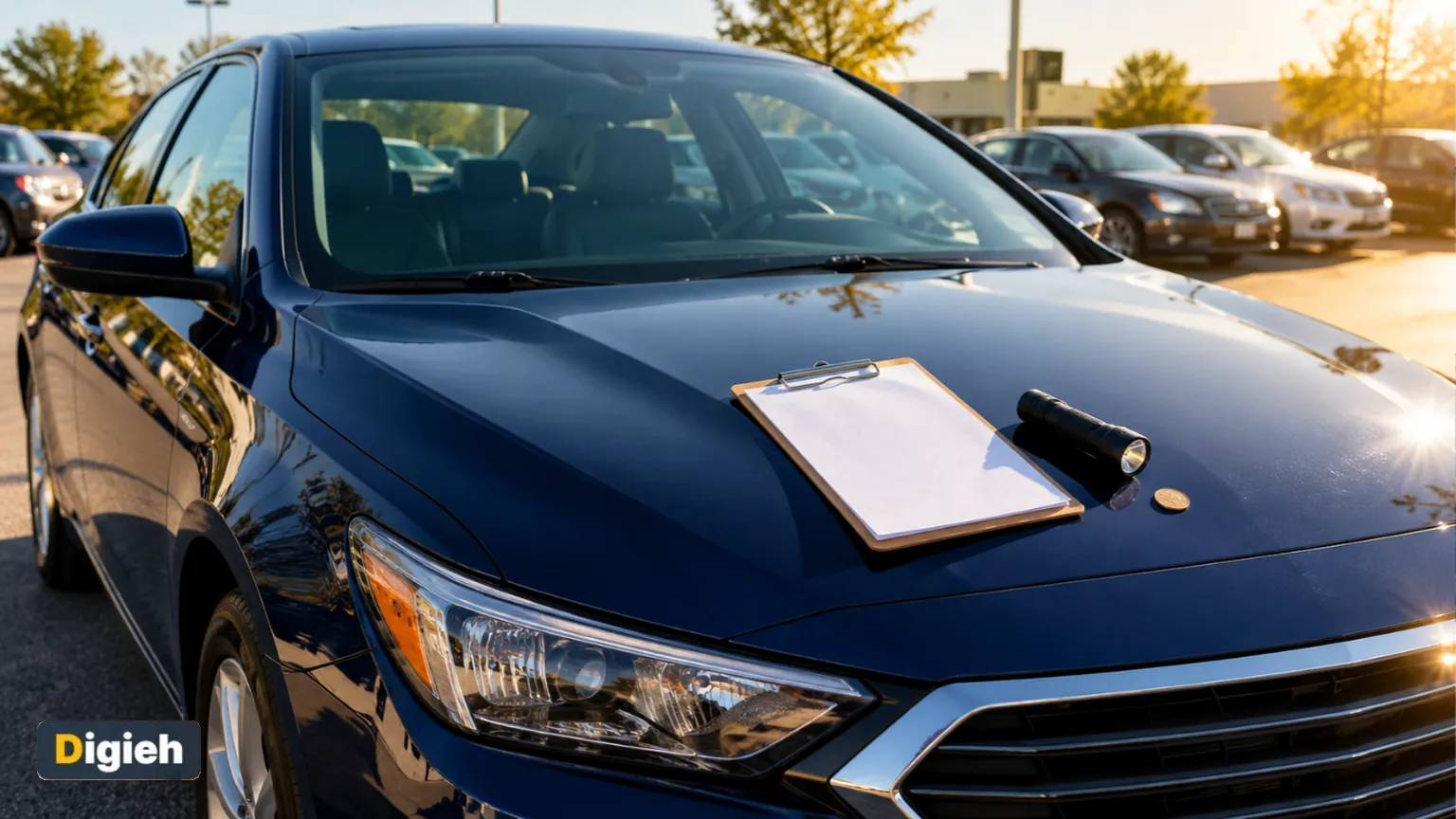
Look at the car in daylight and on level ground. Bring a flashlight and a coin for the tires.
- 6. Body panels. Look for paint that does not match, uneven gaps or ripples. These can point to past crash repairs.
- 7. Rust. Check wheel arches, door bottoms and under the car.
- 8. Tires. Check tread depth and look for uneven wear, which can mean alignment trouble.
- 9. Fluids and leaks. Look under the car for drips and check the oil color.
- 10. Flood signs. Sniff for a musty smell and look for silt or water lines under the carpets.
- 11. Lights and electronics. Test every light, window, lock, the heater and air conditioning.
- 12. Warning lights. All dashboard lights should switch on at start and then go off.
Our penny test guide shows how to check tread in seconds. Not sure what a light means? See dashboard warning lights explained.
Where are you planning to buy your next used car?
- A dealer
- A private seller
- An online car store
- Not sure yet
Test Drive Checks
Drive for at least 20 minutes on city streets and a highway. Start the engine cold if you can, since warm engines hide problems.
- 13. Starting. The engine should start easily and idle smoothly.
- 14. Braking. The car should stop straight, with no grinding or pulsing pedal.
- 15. Steering. It should track straight on a flat road without pulling.
- 16. Shifting. Gear changes should be smooth, with no slipping or clunks.
- 17. Noises. Listen for knocks, whines or rattles over bumps.
Paperwork Checks
Dealers must post a Buyers Guide on each used car, the Federal Trade Commission says. It shows if the car comes with a warranty or is sold “as is.”
The Buyers Guide terms override any opposite terms in the sales contract. “As is” means the dealer gives no warranty.
- 18. Independent inspection. Pay a mechanic you choose to inspect the car before you sign.
- 19. Title and ownership. Match the number on the title with the car, and check the seller name.
- 20. Total price. Ask for the out-the-door price, with taxes, fees and any add-ons listed.
Good to know. The Federal Trade Commission says there is no general right to cancel a used car sale within 3 days. Read every page before you sign.
Add-ons like service contracts or paint protection can add thousands of dollars. You can say no to them, the Federal Trade Commission notes.
The Full 20-Point Used Car Checklist
Save or screenshot this table and take it with you.
| Stage | Checks | Red flag |
|---|---|---|
| At home | 1. Recalls, 2. Title history, 3. Accident history, 4. Fair price, 5. Insurance quote | Salvage or flood brand, open recalls |
| On the lot | 6. Body panels, 7. Rust, 8. Tires, 9. Fluids, 10. Flood signs, 11. Electronics, 12. Warning lights | Musty smell, mismatched paint, lights that stay on |
| Test drive | 13. Starting, 14. Braking, 15. Steering, 16. Shifting, 17. Noises | Grinding brakes, slipping gears |
| Paperwork | 18. Mechanic inspection, 19. Title match, 20. Out-the-door price | Seller refuses an inspection |
Checks are based on the Federal Trade Commission, the recall lookup and the title database. Digieh grouped them.
Free updates
Join the Digieh list
Be the first to know when our weekly brief launches.
No spam. Unsubscribe anytime. Read our Privacy Policy.
Dealer vs Private Seller: Which Suits You?
| Factor | Dealer | Private seller |
|---|---|---|
| Price | Usually higher | Often lower |
| Buyers Guide required | Yes | No |
| Warranty | Sometimes | Rarely, usually “as is” |
| Financing and trade-in | Offered | Not offered |
| Paperwork help | Handled for you | You handle title and registration |
Buyers Guide rules come from the Federal Trade Commission. Other points are general Digieh guidance.
- A dealer suits you if you want financing, a trade-in or a warranty option.
- A private seller suits you if you want a lower price and can handle the paperwork.
- Either way, insist on an independent inspection.
Still deciding if used is right for you? Read our guide on leasing vs buying a car.
Used Car Cost Calculators
Digieh built these two calculators to show the real cost. Use the first for what you pay on day one and the second for monthly running costs.
Out-the-door price
True monthly cost
Insurance can swing your monthly cost a lot. Our guide on how to lower car insurance can help.
Try this today. Book the mechanic inspection before you agree on a price. A seller who will not allow one is a reason to walk away.
Test Yourself
What does “as is” on a dealer Buyers Guide mean?
- The car has passed inspection
- The dealer gives no warranty
- You can return it in 3 days
The Federal Trade Commission says “as is” means the dealer offers no warranty.
Frequently Asked Questions
What should I check before buying a used car?
Check recalls, title history, the body, tires and fluids, and take a test drive. Then get an independent mechanic inspection.
Is a vehicle history report enough?
No. It shows reported accidents and title brands, but not every repair or mechanical problem.
Do I have 3 days to return a used car?
Usually not. There is no federal 3-day cancellation right, so read the contract before you sign.
How do I check a car for recalls?
Enter the vehicle identification number on the National Highway Traffic Safety Administration recall lookup. It is free.
Conclusion
Twenty quick checks can save you from a car with hidden damage or a bad deal. The free recall lookup and a mechanic inspection matter most.
Your next step is to save the checklist table and ask the seller for the vehicle identification number today.
Editor’s Note
This article is accurate as of November 19, 2026. Rules come from the Federal Trade Commission, the National Highway Traffic Safety Administration and the federal title database.
Spot an error in this article? Please contact us at support@digieh.com or read our Corrections Policy.
Keep exploring
Your next read is waiting
 1TechnologyNginx Security Flaws: What Site Owners Must Do4 min read
 2HealthLDL Cholesterol: How to Lower It Without Medication5 min read
 3NewsInstagram School Program Files: What Parents Should Know4 min read
 4Finance & MarketsNvidia Earnings Hit a Record Without Jensen Huang4 min read
 5Pets & AnimalsCat Not Using Litter Box: Causes and Fixes6 min read
 6GamingHow to Reduce Lag and Ping When Gaming8 min read
Found this useful?