TRENDING
Knee Pain: Common Causes, Relief and Warning Signs
Knee pain explained: common causes after injury or with no injury, what pain location may mean, home care, prevention and urgent warning signs. Checker inside.

7 min read
Last updated November 25, 2026
Knee pain usually comes from a sprain, overuse or wear and tear. Most cases get better in a few days with rest, ice and pain relief.
Get urgent help if you cannot put weight on the knee or it changes shape. A hot, red knee with a fever is also urgent.
Health note. This article is for general information only and is not medical advice. See a doctor if your knee pain worries you.
Key Takeaways.
- Sprains, strains and tendon pain are the most common causes after activity.
- Osteoarthritis often causes stiffness in both knees as people get older.
- Ice for up to 20 minutes every 2 to 3 hours, says the National Health Service.
- See a doctor if the pain has not improved within a few weeks.
- A hot, red, swollen knee with a fever can mean infection and needs urgent care.
Jump to a section
- Causes after an injury
- Causes with no injury
- What the pain location may mean
- Risk factors
- Official advice compared
- Should I see a doctor?
- Home care
- Medical treatment
- Prevention
- When to Get Help
- Questions to Ask Your Doctor
- Frequently Asked Questions
- Sources
- Conclusion
Knee Pain After an Injury
| What happened | Likely cause |
|---|---|
| Twisting or overstretching during exercise | Sprain or strain |
| Pain below the kneecap after running or jumping | Tendon irritation |
| A pop, then the knee gives way or will not straighten | Torn ligament or torn cartilage |
| Kneecap moved out of place after a knock or sudden turn | Dislocated kneecap |
| Severe pain and swelling after a fall | Possible broken bone |
Source: National Health Service and Mayo Clinic, checked November 25, 2026.
20 minutesThe longest time to ice a sore knee. Repeat every 2 to 3 hours, says the National Health Service.
Knee Pain With No Obvious Injury
| What you notice | Possible cause |
|---|---|
| Stiffness and mild swelling in both knees, worse with age | Osteoarthritis |
| Warm, red swelling, worse when kneeling | Bursitis |
| Swelling and bruising while taking blood thinners | Bleeding in the joint |
| Sudden, very painful, hot and red knee | Gout or a joint infection |
| Pain and a bump below the kneecap in a teenager | Growth plate irritation from sport |
Source: National Health Service, checked November 25, 2026.
Sudden hot, red joints are a classic gout sign. Read our guide to gout attacks and relief.
What the Pain Location May Mean
| Where it hurts | Often linked to |
|---|---|
| Front of the knee, around the kneecap | Kneecap pain from running, stairs or squatting |
| Just below the kneecap | Tendon irritation from jumping |
| Inner side | Cartilage tear or wear and tear |
| Outer side | Tight band of tissue along the thigh, common in runners |
| Back of the knee | A fluid-filled swelling, or rarely a blood clot |
Source: Digieh summary built from Mayo Clinic and MedlinePlus. Only a doctor can confirm the cause.
Warning. A painful, swollen, warm calf with pain behind the knee can be a blood clot. Get urgent medical help.
What caused your knee pain?
- Sport or exercise
- A fall or knock
- No clear reason
- Not sure
Risk Factors
- Extra weight: adds stress to the knee joints.
- Weak or tight leg muscles: less support for the knee.
- High-impact sports: basketball, football, skiing and running.
- Physically demanding jobs with kneeling or lifting.
- A previous knee injury.
These come from Mayo Clinic.
Official Advice Compared
| Question | National Health Service (UK) | Mayo Clinic (US) |
|---|---|---|
| First steps | Rest, ice, painkillers or gel | Rest, ice, gentle movement, pain relief |
| How long to improve | A few days, see a doctor after a few weeks | Depends on the cause |
| Urgent signs | Cannot bear weight, changed shape, locking, fever | Cannot bear weight, unstable, deformity, fever |
| Physiotherapy | Can refer yourself in many areas | Strengthening the thigh muscles helps |
| Prevention | Not covered on the page | Healthy weight, strength, stretching, low-impact exercise |
Sources: National Health Service and Mayo Clinic, checked November 25, 2026.
Should I See a Doctor?
Tap the signs you have. The bars show the level of care that fits best. This is a guide, not a diagnosis.
- Mild ache after exercise
- Stiff knees in the morning that ease
- Pain for more than a few weeks
- Knee gives way or locks
- Heard a pop and it swelled fast
- Cannot put weight on it
- Knee looks out of shape
- Hot, red knee with fever
- Swollen, painful calf too
Home Care That Helps
- Take weight off the knee and avoid standing for long periods.
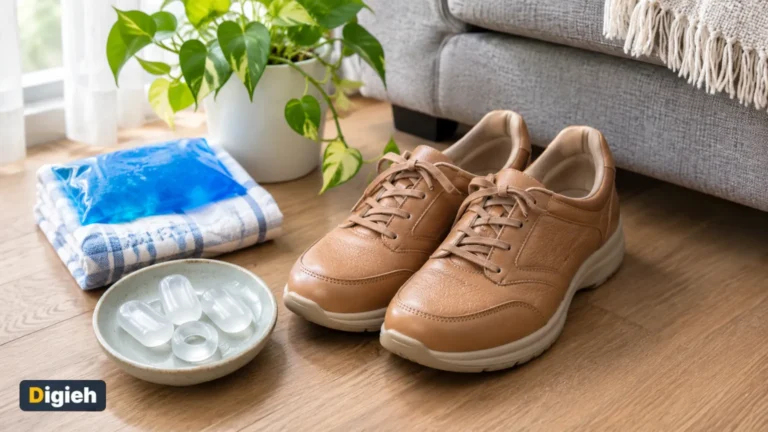
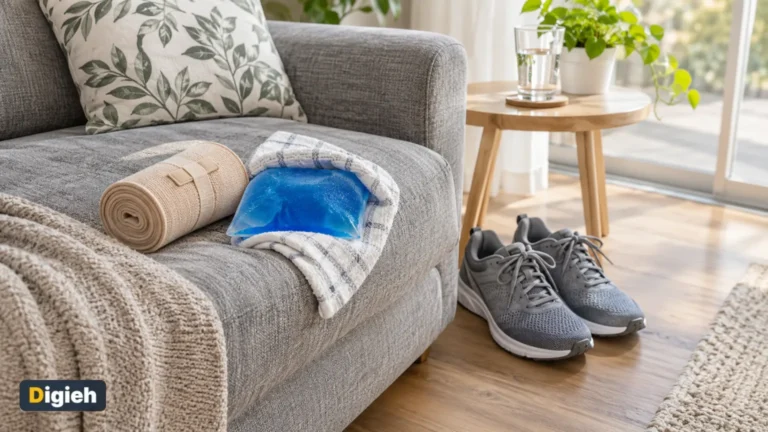
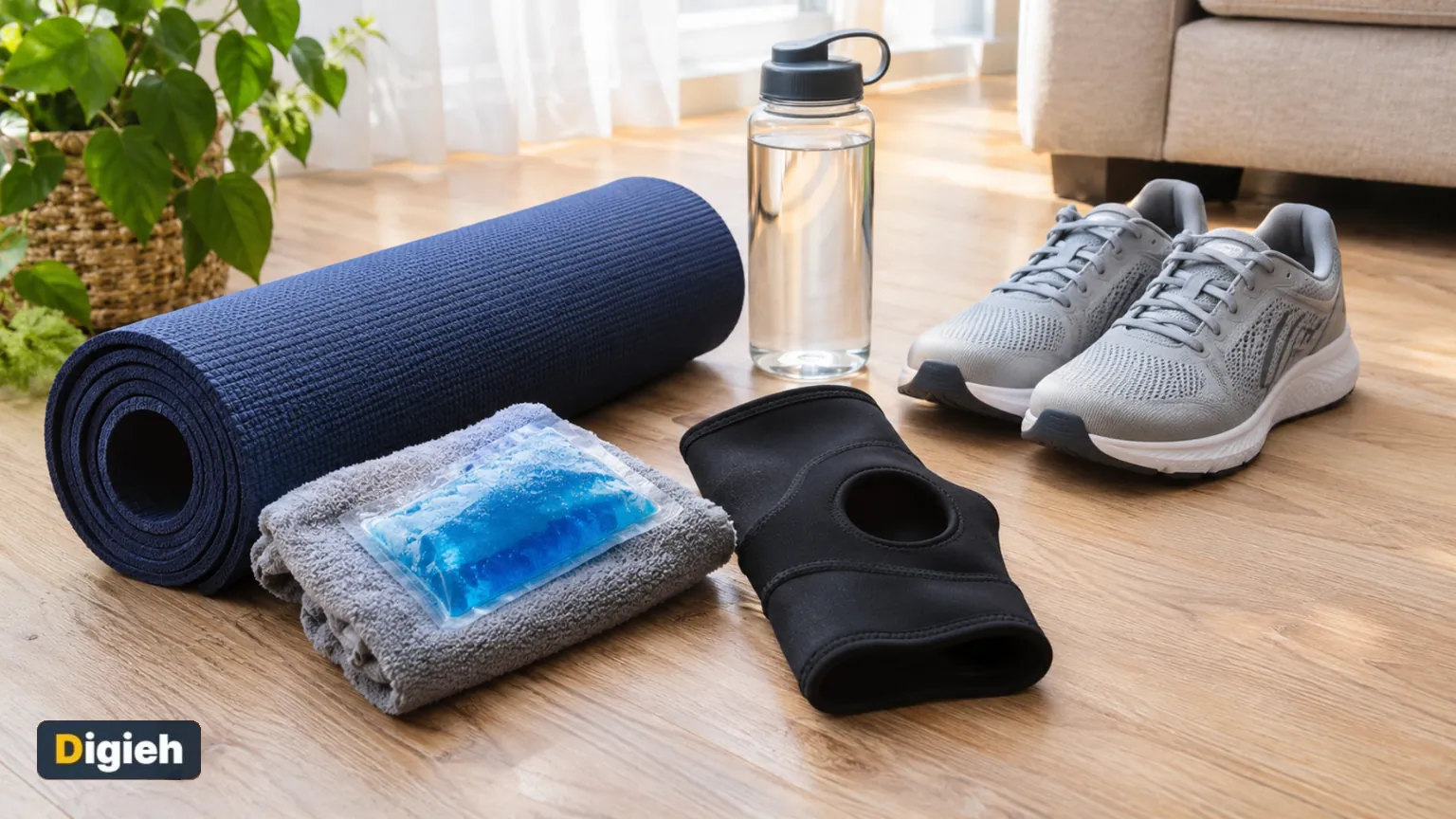
- Hold an ice pack wrapped in a cloth on it for up to 20 minutes, every 2 to 3 hours.
- Use paracetamol, or ibuprofen tablets or gel if they are safe for you.
- Raise your leg on a pillow when resting.
- Move it gently once the worst pain eases, to stop it stiffening.
- Wear supportive, cushioned shoes.
These steps come from the National Health Service. Most knee pain starts to feel better within a few days.
Try this today. Today, rest your leg on a pillow and ice the knee for 15 minutes. Keep a towel between the ice and your skin.
Runners often get knee pain from worn or wrong shoes. See our guide to choosing running shoes.
Not sure which kind of arthritis you have? See osteoarthritis vs rheumatoid arthritis compared.
Free updates
Join the Digieh list
Be the first to know when our weekly brief launches.
No spam. Unsubscribe anytime. Read our Privacy Policy.
Knee Pain in Older Adults
Osteoarthritis is the most common cause of knee pain in people over 50. The cartilage that cushions the joint slowly wears down.
Staying active helps, even though it may hurt at first. Strong thigh muscles take pressure off the joint.
Losing a little weight can ease knee pain a lot. Swimming, cycling and walking in water are gentle choices.
Knee pain at night, or pain that keeps you from daily tasks, is worth a doctor visit. Treatments such as physiotherapy, injections or joint surgery can help when simple steps are not enough.
Medical Treatment
A doctor will examine your knee and ask how the pain started. You may need an X-ray or scan if a tear or broken bone is likely.
- Medicines: stronger pain relief or anti-inflammatory tablets.
- Physiotherapy: exercises to strengthen the thigh and hip muscles.
- Injections: sometimes used for arthritis or bursitis.
- Draining fluid from a swollen joint, and testing it for infection or gout.
- Surgery: for some ligament or cartilage tears.
In many parts of the United Kingdom, you can refer yourself to physiotherapy. You do not need to see a doctor first, the National Health Service says.
How to Prevent Knee Pain
- Keep a healthy weight.
- Strengthen your thigh and hamstring muscles.
- Stretch regularly.
- Warm up before sport and use good technique.
- Choose swimming or cycling if you have arthritis or keep getting pain.
- Build up exercise slowly.
These tips come from Mayo Clinic. Walking is still good for most knees, see our guide to starting a walking routine.
How often can you ice a sore knee, according to the National Health Service?
- Up to 20 minutes every 2 to 3 hours
- For an hour at a time
- Once a week
Use a wrapped ice pack for up to 20 minutes. Repeat every 2 to 3 hours, the National Health Service says.
When to Get Help
Get urgent help if the knee is very painful or you cannot put weight on it. The same goes if it is badly swollen or has changed shape.
Also get urgent care if it locks or gives way. A fever with a hot, red knee is urgent too. The National Health Service lists these as urgent signs.
Go to emergency care for a swollen, painful calf, or chest pain and breathlessness. These can be signs of a blood clot.
See a doctor if the pain has not improved within a few weeks.
Questions to Ask Your Doctor
- What is causing my knee pain?
- Do I need an X-ray or scan?
- Which exercises are safe for me?
- Should I see a physiotherapist?
- How long should I rest it?
- Can I keep running or playing sport?
- What signs mean I should come back sooner?
Frequently Asked Questions
Should I walk on a sore knee?
Gentle movement is fine once the worst pain eases. Rest it if walking makes the pain much worse.
How do I know if knee pain is serious?
Not being able to bear weight, a changed shape, locking or a hot red knee with fever are serious signs.
Is heat or ice better for knee pain?
Ice helps fresh injuries and swelling. Heat can ease stiffness from arthritis.
What is the most common cause?
Sprains and overuse in active people, and osteoarthritis in older adults.
Sources
Conclusion
Most knee pain is minor and gets better with simple care. Knowing the warning signs keeps you safe.
Next step: rest and ice your knee for a few days. Book a doctor visit if it is not better in a few weeks.
Editor’s Note
This article is accurate as of November 25, 2026. Facts come from the National Health Service, Mayo Clinic and MedlinePlus.
Spot an error in this article? Please contact us at support@digieh.com or read our Corrections Policy.
Keep exploring
Your next read is waiting
 1HealthCarpal Tunnel Syndrome: Symptoms, Causes and Relief Tips7 min read
 2Finance & MarketsJensen Huang Returns to Lead Nvidia After Resigning4 min read
 3Pets & AnimalsHow to Choose Dog Food: Reading the Label7 min read
 4Parenting & FamilyFood Stamp Rule Could Change Free School Meals4 min read
 5AI & TechChatGPT Classic Is Retiring: How to Switch Apps4 min read
 6NewsThanksgiving Storm 2026: Where Travel Delays Are Likely4 min read
Found this useful?