TRENDING
Plantar Fasciitis: Heel Pain Causes, Stretches and Relief
Plantar fasciitis explained: why heels hurt in the morning, risk factors, a simple morning routine, stretches, shoe tips, treatment and when to see a doctor.

8 min read
Last updated November 24, 2026
Plantar fasciitis is the most common cause of heel pain in adults. The pain is usually worst with your first steps in the morning.
Stretches, ice, good shoes and rest help most people get better within a few months. Surgery is rarely needed.
Health note. This article is for general information only and is not medical advice. Talk to a doctor, physiotherapist or podiatrist about your pain.
Key Takeaways.
- Plantar fasciitis is strain of the tissue band under your foot that joins your heel to your toes.
- Pain is often sharpest with the first steps after sleep or sitting.
- It is most common between ages 40 and 60.
- Most people recover within a few months without surgery, says Mayo Clinic.
- Tingling, numbness or foot pain with diabetes needs a doctor visit.
Jump to a section
- What plantar fasciitis is
- Symptoms
- Causes and risk factors
- Official advice compared
- Should I see a doctor?
- A morning routine for heel pain
- Stretches
- Shoes and insoles
- What to avoid
- Medical treatment
- When to Get Help
- Questions to Ask Your Doctor
- Frequently Asked Questions
- Sources
- Conclusion
What Is Plantar Fasciitis?
The plantar fascia is a tough band of tissue along the bottom of your foot. It runs from your heel bone to your toes and supports your arch.
Repeated strain can irritate this band and cause small tears. That makes your heel and arch hurt when you stand or walk.
1 in 10People who get plantar fasciitis at some point, says Cleveland Clinic. Over 2 million Americans are treated for it each year.
Plantar Fasciitis Symptoms
- Sharp or stabbing pain on the bottom of the foot near the heel.
- Pain that is worst with your first steps after sleep or rest.
- Pain that eases as you move, then returns after long standing or walking.
- Pain when you raise your toes or climb stairs.
- Pain usually in one foot, though both can be affected.
These signs come from the National Health Service and Mayo Clinic.
Is it a heel spur?
About half of people with plantar fasciitis also have a heel spur on an X-ray. Harvard Health says the spur itself usually does not cause the pain.
Causes and Risk Factors
| Risk factor | Why it matters |
|---|---|
| Age 40 to 60 | The tissue loses some stretch with age |
| Running and jumping sports | Repeated impact strains the heel |
| Flat feet or high arches | Weight spreads unevenly across the foot |
| Extra body weight | More load lands on the heel with each step |
| Long hours standing on hard floors | Constant pressure on the tissue band |
| Worn or unsupportive shoes | Less cushioning and arch support |
| Tight calf muscles | They pull on the heel and fascia |
Source: National Health Service and Mayo Clinic.
A sudden jump in exercise is a common trigger. If you run, see our guide to choosing running shoes.
Official Advice Compared
| Question | National Health Service (UK) | Mayo Clinic (US) | Cleveland Clinic (US) |
|---|---|---|---|
| How to ice | Wrapped ice pack up to 20 minutes, every 2 to 3 hours | 15 minutes, 3 or 4 times a day | 10 to 15 minutes, twice a day |
| Shoes | Cushioned shoes with arch support, insoles or heel pads | Supportive shoes, replace worn sports shoes | Supportive shoes and inserts |
| Pain relief | Paracetamol or ibuprofen, ask a pharmacist | Ibuprofen or naproxen | Not covered on this page |
| See a doctor when? | No better after 2 weeks of self-care | Not covered on this page | Pain over a week, or no better after 2 weeks of treatment |
| Recovery time | Not stated | Most recover within a few months | A few weeks to a few months |
Sources: National Health Service, Mayo Clinic and Cleveland Clinic, checked November 24, 2026.
The ice timings differ, but all three agree on short sessions with a towel between ice and skin. Pick the schedule you can keep.
Should I See a Doctor?
Tap the signs you have. The bars show which level of care fits best. This is a guide, not a diagnosis.
- Heel pain with first morning steps
- Pain after long standing or a run
- No better after 2 weeks of self-care
- Pain that stops normal activities
- Pain getting worse or keeps coming back
- Tingling or numbness in the foot
- Foot pain and I have diabetes
- Heel pain with fever, redness or warmth
- Pain right after a fall or injury
- Cannot put any weight on the foot
When does your heel hurt most?
- First steps in the morning
- After sitting
- After exercise
- Not sure
A Morning Routine for Heel Pain
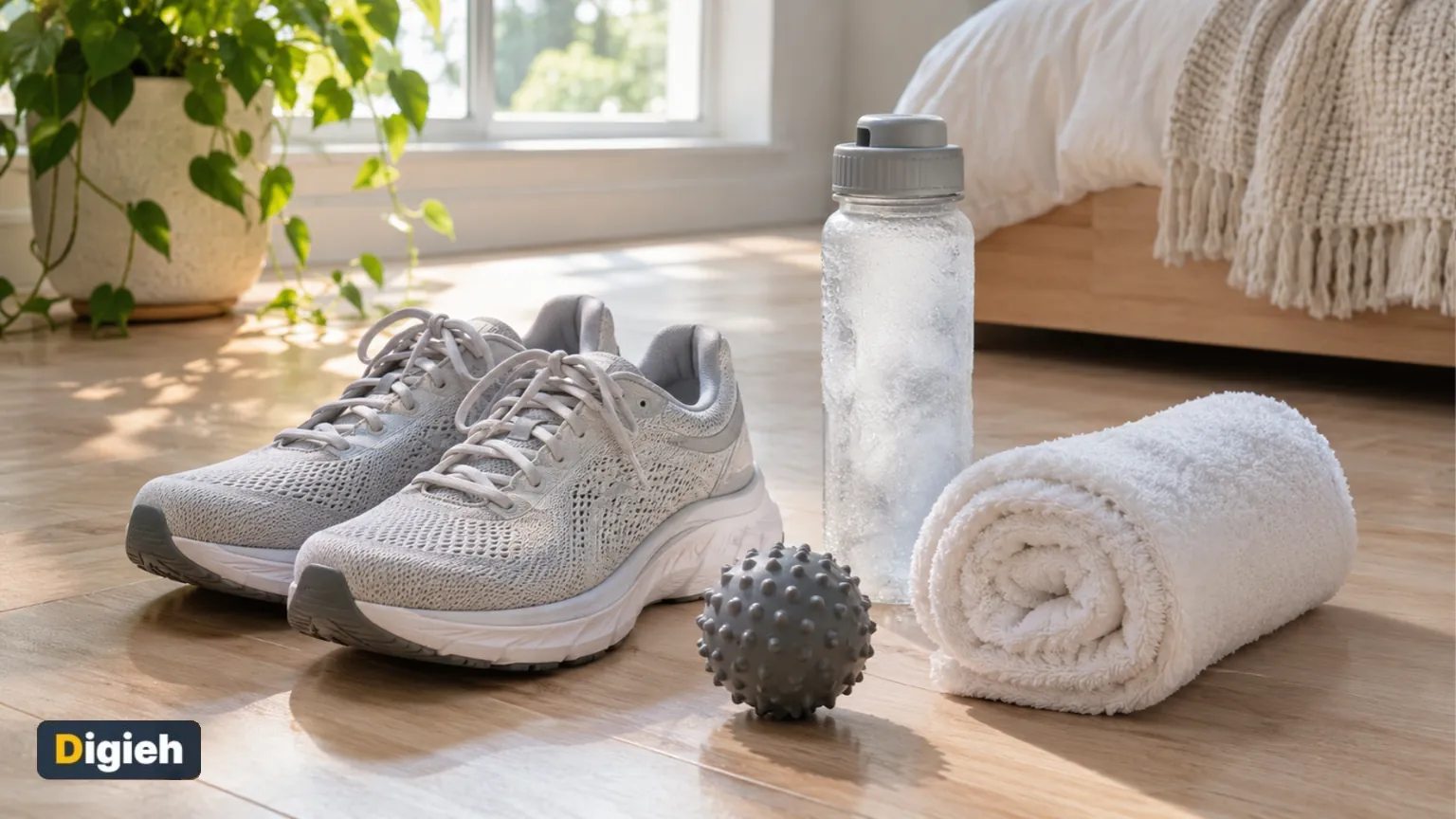
First steps hurt most because the tissue tightens overnight. We built this short routine from official stretch and ice advice.
| When | What to do |
|---|---|
| Before you get up | Pull your toes back toward your shin for 15 seconds, 3 times |
| Sitting on the bed | Roll your foot over a bottle or ball for 1 to 2 minutes |
| First steps | Put on supportive shoes or slippers, not bare feet |
| During the day | Do a calf stretch after long sitting |
| Evening | Roll your foot on a frozen water bottle wrapped in a thin towel |
Source: built by Digieh from Mayo Clinic, Cleveland Clinic and National Health Service advice.
Try this today. Tonight, put a water bottle in the freezer and leave supportive slippers next to your bed.
Stretches for Plantar Fasciitis
Stretching the arch, calf and Achilles tendon helps ease pain, says Mayo Clinic. Do them several times a day.
Calf stretch against a wall
- Stand facing a wall with your hands on it.
- Step the sore foot back and keep that heel on the floor.
- Bend the front knee until you feel a stretch in the back calf.
- Hold for 15 to 30 seconds and repeat 3 times.
Towel stretch
- Sit with your leg straight in front of you.
- Loop a towel around the ball of your foot.
- Gently pull the towel toward you, keeping your knee straight.
- Hold for 15 to 30 seconds and repeat 3 times.
Toe stretch
- Sit and cross the sore foot over your other knee.
- Pull your toes back toward your shin until you feel the arch stretch.
- Hold for 15 seconds and repeat 5 times.
The American Academy of Family Physicians suggests 15-second holds repeated 5 times. For more routines, see our warm-up and cool-down guide.
Go gently. A stretch should feel mild. Stop if the pain gets sharper.
Free updates
Join the Digieh list
Be the first to know when our weekly brief launches.
No spam. Unsubscribe anytime. Read our Privacy Policy.
Shoes and Insoles
- Choose shoes with good cushioning and arch support.
- Try store-bought arch supports or heel pads.
- Replace worn-out sports shoes.
- Wear shoes indoors on hard floors.
- Ask a podiatrist about custom insoles if store ones do not help.
These tips come from the National Health Service and Mayo Clinic.
What to Avoid
- Walking barefoot on hard floors.
- Flip-flops, backless slippers and flat shoes.
- High heels and tight, pointed shoes.
- Long periods of standing or walking.
- Running and jumping until the pain settles. Swimming and cycling are gentler.
Want to stay active? Our guide to walking for fitness explains how to build up slowly.
Medical Treatment
Most people do not need scans. A doctor can usually tell from your symptoms and by pressing on your heel, says Mayo Clinic.
- Physiotherapy with stretching and strengthening exercises.
- Night splints that keep the foot stretched while you sleep.
- Custom insoles from a podiatrist.
- A walking boot for a short time to rest the foot.
- Steroid injections for short-term relief.
- Shockwave therapy for long-lasting pain.
- Surgery, which is rarely needed.
Mayo Clinic warns that repeated steroid injections can weaken the tissue. Procedures are usually tried only after several months without improvement.
Medicine note. We do not list doses. Follow the label and ask your pharmacist. See our acetaminophen vs ibuprofen guide.
Plantar Fasciitis Myths
- Myth: The heel spur is the problem. Spurs usually do not cause the pain.
- Myth: You need surgery. Most people get better with simple care.
- Myth: Walking through the pain fixes it. Rest from high-impact activity helps it heal.
When does plantar fasciitis pain usually feel worst?
- With the first steps in the morning
- Late at night in bed
- Only while running
Pain is usually worst with the first steps after sleep or rest.
When to Get Help
See a doctor soon if heel pain comes with fever, redness or warmth. Alberta Health Services says this needs prompt care.
Also seek care if you cannot put weight on the foot after an injury. That could be a fracture.
Book a doctor visit if pain is not better after 2 weeks of self-care, or you have tingling or numbness. People with diabetes should get foot pain checked, says the National Health Service.
Foot problems can be more serious with diabetes. Read our guide to type 2 diabetes symptoms.
Questions to Ask Your Doctor
- Is this plantar fasciitis or something else?
- Do I need an X-ray or scan?
- Which stretches are safe for me?
- Would insoles or a night splint help?
- Should I see a physiotherapist or podiatrist?
- When can I go back to running or sports?
- What should I try if it is not better in a few months?
Frequently Asked Questions
How long does plantar fasciitis take to heal?
Most people get better within a few months. Some cases take up to a year.
Is walking good for plantar fasciitis?
Gentle walking in supportive shoes is usually fine. Cut back on long walks and running while it hurts.
Should I use heat or ice?
Official advice suggests ice in short sessions, wrapped in a towel. Rolling a frozen bottle under your foot works well.
Can plantar fasciitis come back?
Yes. Keep stretching, wear supportive shoes and build up exercise slowly to lower the chance.
Sources
- National Health Service: Plantar fasciitis
- Mayo Clinic: Symptoms and causes
- Mayo Clinic: Diagnosis and treatment
- Cleveland Clinic: Plantar fasciitis
- Harvard Health: Easing the pain of plantar fasciitis
Conclusion
Plantar fasciitis is painful but usually gets better with simple care. Stretching, ice and supportive shoes do most of the work.
Next step: try the toe stretch before you get out of bed tomorrow.
Editor’s Note
This article is accurate as of November 24, 2026. Facts come from the National Health Service, Mayo Clinic, Cleveland Clinic and Harvard Health.
Spot an error in this article? Please contact us at support@digieh.com or read our Corrections Policy.
Keep exploring
Your next read is waiting
 1HealthBlood Sugar Spikes: Causes, Symptoms and Prevention Tips7 min read
 2Finance & MarketsThe World’s 10 Biggest IPOs in History, Ranked5 min read
 3SportsVerstappen Wins 2026 Las Vegas Grand Prix: Results4 min read
 4TechnologyHumanize AI Text: Make Your Writing Sound Natural9 min read
 5NewsCOP31 Ends Without Deal: What Happened in Antalya4 min read
 6Education & CareersHow to Make a Quiz: Step by Step9 min read
Found this useful?