TRENDING
Onion Health Benefits and How to Cut Tearlessly

9 min read
Last updated November 10, 2026
Onions add big flavor to food with very few calories and no fat or sodium. A medium onion has about 44 calories and 2 grams of fiber, according to University of Minnesota Extension.
They also make many cooks cry. A 2025 Cornell University study found that slow cuts with a sharp knife reduce the tear-causing spray.
This guide covers onion nutrition, the main types of onions and the science-backed way to cut them with fewer tears.
Health note. This article shares general nutrition information, not medical advice. Talk with your doctor or a registered dietitian about your own diet, especially if onions upset your stomach.
Key Takeaways
- A medium onion has about 44 calories and 2 grams of fiber.
- Onions add flavor without sodium or fat.
- A chemical spray released during cutting makes your eyes sting.
- Slow cuts with a sharp knife reduce that spray.
- Onions are toxic to cats and dogs.
Jump to a section
- Nutrition facts
- Health benefits
- Types of onions
- Why onions make you cry
- How to cut without tears
- Buying and storing
- Onions and digestion
- Onions and pets
- Frequently asked questions
Onion Nutrition Facts
University of Minnesota Extension lists these values for one medium onion.
| Nutrient | Amount in one medium onion |
|---|---|
| Calories | 44 |
| Carbohydrates | 10 grams |
| Fiber | 2 grams |
| Potassium | 161 mg |
| Vitamin C | 8 mg |
| Calcium | 25 mg |
| Magnesium | 11 mg |
The Extension notes that onions also contain small amounts of iron and folate. Most people eat onions in small amounts, so they add flavor more than bulk nutrition.
40 m/sThe top estimated speed of the onion mist released during cutting, per a 2025 Cornell study.
Health Benefits of Onions
University of Minnesota Extension describes onions as full of antioxidants. Antioxidants help protect cells from damage.
The Extension also points out that onions add flavor without adding sodium or fat. That makes them a useful tool for cutting back on salt.
| Benefit | Why it matters |
|---|---|
| Low calorie | Adds flavor for few calories |
| No sodium | Helps you season food with less salt |
| Fiber | Supports digestion and fullness |
| Vitamin C | Supports healing and immune function |
| Plant compounds | Add antioxidants to your diet |
Onions belong to the allium family, along with garlic, leeks and chives. Read our guide to garlic health benefits to learn about its close cousin.
Onions also help you reach your fiber goal. See our list of high fiber fruits and vegetables for more ideas.
Quick tip. Saute onions slowly in a little oil before adding salt. Their natural sweetness means you may need less salt overall.
Types of Onions
| Type | Flavor | Best for |
|---|---|---|
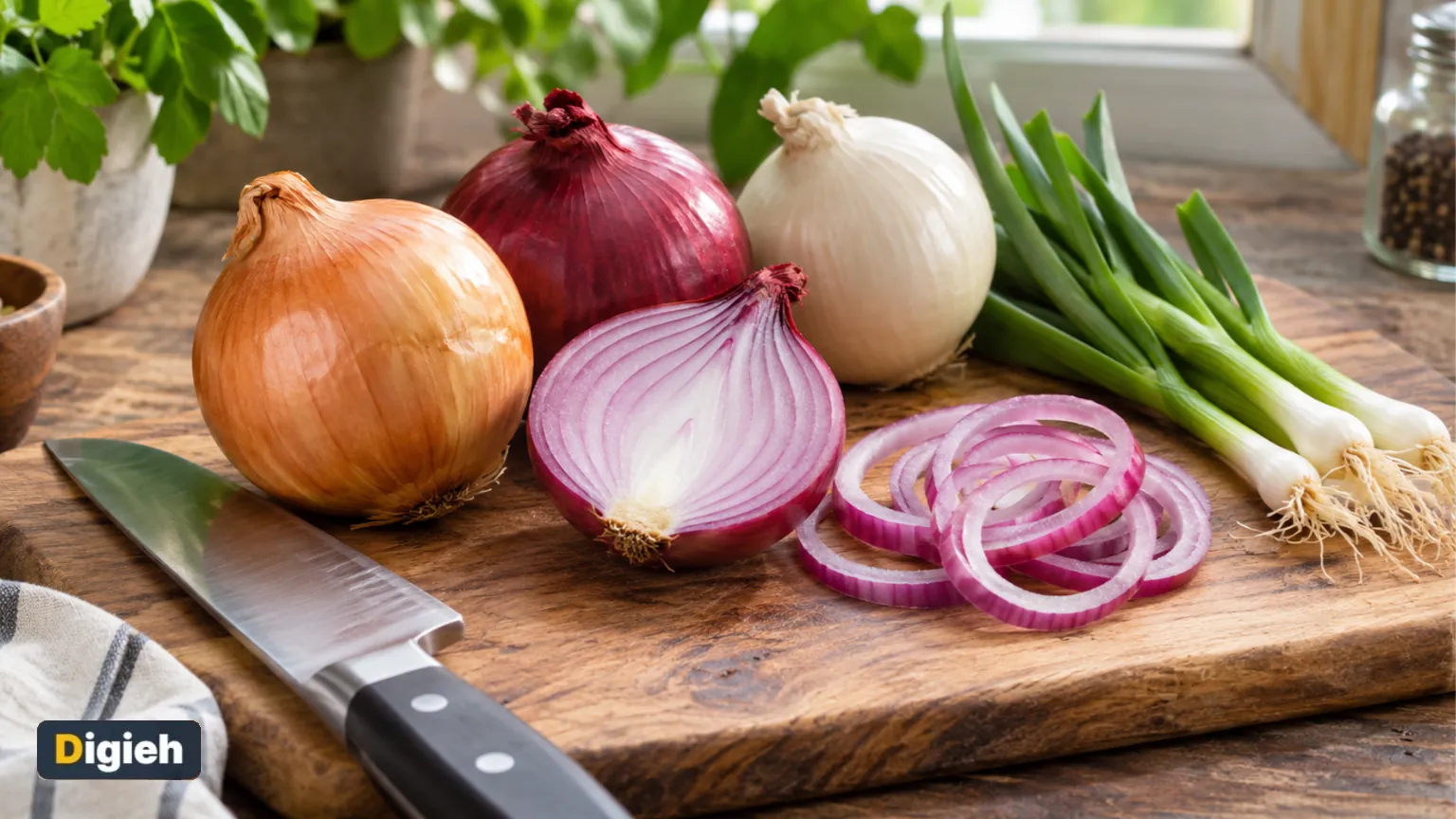
| Yellow | Balanced, sweet when cooked | Soups, stews, caramelizing |
| White | Sharp and crisp | Salsa, tacos, stir fries |
| Red | Mild and colorful | Salads, sandwiches, pickling |
| Sweet, like Vidalia | Very mild | Raw slices, onion rings |
| Shallots | Delicate and mild | Dressings and sauces |
| Green onions | Fresh and light | Garnishes and quick cooking |
Yellow onions are the everyday workhorse. They turn deep brown and sweet when you cook them slowly.
That slow cooking is the heart of our French onion soup recipe.
Why Onions Make You Cry
Cutting an onion breaks open its cells. That triggers a chemical reaction that forms a compound called propanethial S-oxide.
When this compound reaches your eyes, it stings and makes them water. Your tears are your body trying to wash away the irritant.
Cornell researchers filmed onion cutting with high speed cameras. They found that cutting ejects pungent mist up to two thirds of a meter into the air.
Pressing the knife builds pressure inside the onion. When the blade breaks through the skin, a burst of tiny droplets sprays out much faster than the knife moves.
Do onions make you cry when you cut them?
- Every time
- Sometimes
- Rarely
- Not sure
How to Cut Onions Without Crying
The Cornell team recommends cutting onions slowly with a sharpened blade. Science News Explores reports that a sharp blade crushes fewer cells and releases less juice.
The researchers found that slow, steady cuts kept droplets from even reaching eye level. Quick cuts with a dull blade launched droplets much faster.
- Sharpen your knife before you start.
- Rinse and dry the onion.
- Slice off the stem end but leave the root end on.
- Cut the onion in half from top to root and peel off the skin.
- Lay each half flat and make slow, steady cuts.
- Cut toward the root and remove it last.
University of Minnesota Extension also suggests keeping the root end intact to help with cutting. The root holds the layers together.
A dull knife is both less safe and more tearful. Our guide on how to sharpen kitchen knives walks you through it.
Other Tricks People Try
| Trick | Does it help? |
|---|---|
| Sharp knife and slow cuts | Yes, backed by the Cornell study |
| Chilling the onion first | Many cooks say it helps |
| Cutting near a fan or open window | May blow the mist away |
| Wearing kitchen goggles | Blocks droplets from your eyes |
| Holding bread in your mouth | No good evidence |
Goggles look silly but work because they keep the mist out of your eyes. A fan can help move the droplets away from your face.
Raw vs Cooked Onions
Raw onions have a sharp bite and a satisfying crunch. Cooking softens them and brings out their natural sweetness.
| Feature | Raw onions | Cooked onions |
|---|---|---|
| Flavor | Sharp and pungent | Mellow and sweet |
| Texture | Crisp | Soft |
| Digestion | Harder for some people | Often easier |
| Best uses | Salads, salsa, sandwiches | Soups, stews, sauces |
Soaking sliced raw onions in cold water for a few minutes can tame their bite. This trick works well for salads and burgers.
All About Green Onions
Green onions, also called scallions, are young onions harvested before the bulb grows large. Both the white and green parts are edible.
- Use the white parts in cooking for stronger flavor.
- Slice the green tops raw as a fresh garnish.
- Add them to eggs, rice and noodle dishes.
- Wrap them in a damp paper towel in the fridge.
Green onions give a mild onion flavor without much prep. They also regrow easily from the root ends.
How to Buy Onions
University of Minnesota Extension advises choosing onions that are firm and dry with bright, smooth outer skins.
- Avoid onions with soft spots or mold.
- Skip onions that are sprouting.
- Pick onions that feel heavy for their size.
- Choose green onions with crisp, bright green tops.
Free updates
Join the Digieh list
Be the first to know when our weekly brief launches.
No spam. Unsubscribe anytime. Read our Privacy Policy.
How to Store Onions
The Extension says to store whole onions in a cool, dark, well-ventilated place for up to four weeks.
- Keep whole onions out of plastic bags.
- Store cut onions in a tightly sealed container in the fridge.
- Use cut onions within two to three days.
- Trim bruised parts and cook them, or toss badly bruised onions.
Keep onions away from potatoes in storage, since many cooks find they spoil faster together. For more advice, see how to store fruits and vegetables.
How to Wash Onions
The Extension recommends rinsing onions under running water, cleaning the roots and stems well. Dry them with a paper towel before cutting.
Our guide on how to wash fruits and vegetables covers produce safety in more detail.
Onions and Digestion
Onions contain natural carbohydrates that some people find hard to digest. They may cause gas or bloating, especially when eaten raw or in large amounts.
- Try cooked onions, which many people tolerate better.
- Start with small amounts.
- Use green onion tops for milder flavor.
- Talk with a dietitian if onions often upset your stomach.
People following a special diet for digestive problems may need to limit onions. A registered dietitian can help you find good substitutes.
Keep Onions Away From Pets
The ASPCA warns that onion, garlic and chives can cause stomach irritation and red blood cell damage in pets. This can lead to anemia.
The ASPCA notes that cats are more sensitive, but dogs are also at risk depending on how much they eat.
- Never feed pets foods cooked with onions.
- Watch for onion in gravy, stuffing and leftovers.
- Keep onion powder and soup mixes out of reach.
- Call your veterinarian if your pet eats onions.
Holiday leftovers are a common risk. See our winter pet safety tips for more advice.
Easy Ways to Cook With Onions
- Caramelize onions for burgers and sandwiches.
- Add diced onion to soups, stews and chili.
- Roast onion wedges with other vegetables.
- Pickle red onions for salads and tacos.
- Slice raw sweet onions onto salads.
Onions form the base of many comfort foods. Try them in our hearty beef stew recipe or our easy homemade stuffing recipe.
They also pair well with tomatoes. Learn more in our guide to tomato health benefits, or simmer both in our easy vegetable soup recipe.
How to Caramelize Onions
- Slice yellow onions thinly.
- Cook them in a little oil or butter over medium low heat.
- Stir every few minutes and add a splash of water if they stick.
- Keep cooking until deep golden brown and soft.
Caramelizing takes patience, often close to an hour. The slow heat turns the natural sugars sweet and rich.
Saving Money on Onions
- Buy onions in bags, which often cost less per pound.
- Store them well so none go to waste.
- Chop and freeze extra onions for cooking.
- Regrow green onions from their roots in a glass of water.
Frozen chopped onions work well in soups and sauces. They save time on busy weeknights too.
Onion Myths
| Myth | Fact |
|---|---|
| Cut onions are poisonous after a day | Stored properly, they are fine for two to three days |
| Red onions are much healthier | All onions offer similar nutrition |
| Crying is unavoidable | Sharp knives and slow cuts reduce tears |
| Onions are safe for dogs in small amounts | Onions can harm pets |
Onions are a simple, healthy staple. Store them well and cut them carefully, and they will serve you well.
Your Onion Checklist
- Pick firm, dry onions
- Store whole onions somewhere cool and dark
- Refrigerate cut onions in a sealed container
- Sharpen your knife before chopping
- Cut slowly to reduce tears
- Keep onions away from pets
Try this today. Sharpen your knife, then slice an onion slowly and steadily. Notice how much less your eyes sting.
Test Yourself
What did Cornell researchers find reduces onion tears?
- Fast cuts with any knife
- Slow cuts with a sharp knife
- Cutting onions in hot water
Slow cuts with a sharp blade reduce the spray of irritating droplets.
Frequently Asked Questions
How many calories are in an onion?
About 44 calories in one medium onion.
Why do onions make you cry?
Cutting releases an irritating compound that stings your eyes.
Should onions go in the fridge?
Only cut onions. Store whole onions somewhere cool and dark.
Are onions safe for dogs?
No. Onions can damage red blood cells in pets.
Conclusion
Onions are a low calorie way to add flavor without salt or fat. They offer fiber, vitamin C and antioxidants.
Cut them slowly with a sharp knife, store them well and keep them away from pets.
Found this useful?
Editor’s Note
This guide is accurate as of November 10, 2026. It draws on University of Minnesota Extension, Cornell University, Science News Explores and the ASPCA.
Ask a dietitian for advice if onions bother your digestion.
Spot an error in this article? Please contact us at support@digieh.com or read our Corrections Policy.
Keep exploring
Your next read is waiting
 1Fruits & VegetablesPineapple Health Benefits and How to Cut It9 min read
 2MedicinesElectrolytes Explained: When You Need Them, When Not9 min read
 3Travel & TourismHow to Pack a Carry-On for a Week9 min read
 4AI & TechClaude Fable 5.2 and Mythos 5.2: What Changed4 min read
 5Science & DiscoveriesQuadrantid Meteor Shower 2027: Best Time to Watch9 min read
 6FashionHow to Style a Long Coat Every Day9 min read