TRENDING
Why Beta Pictoris Has a Huge Cat Tail

4 min read
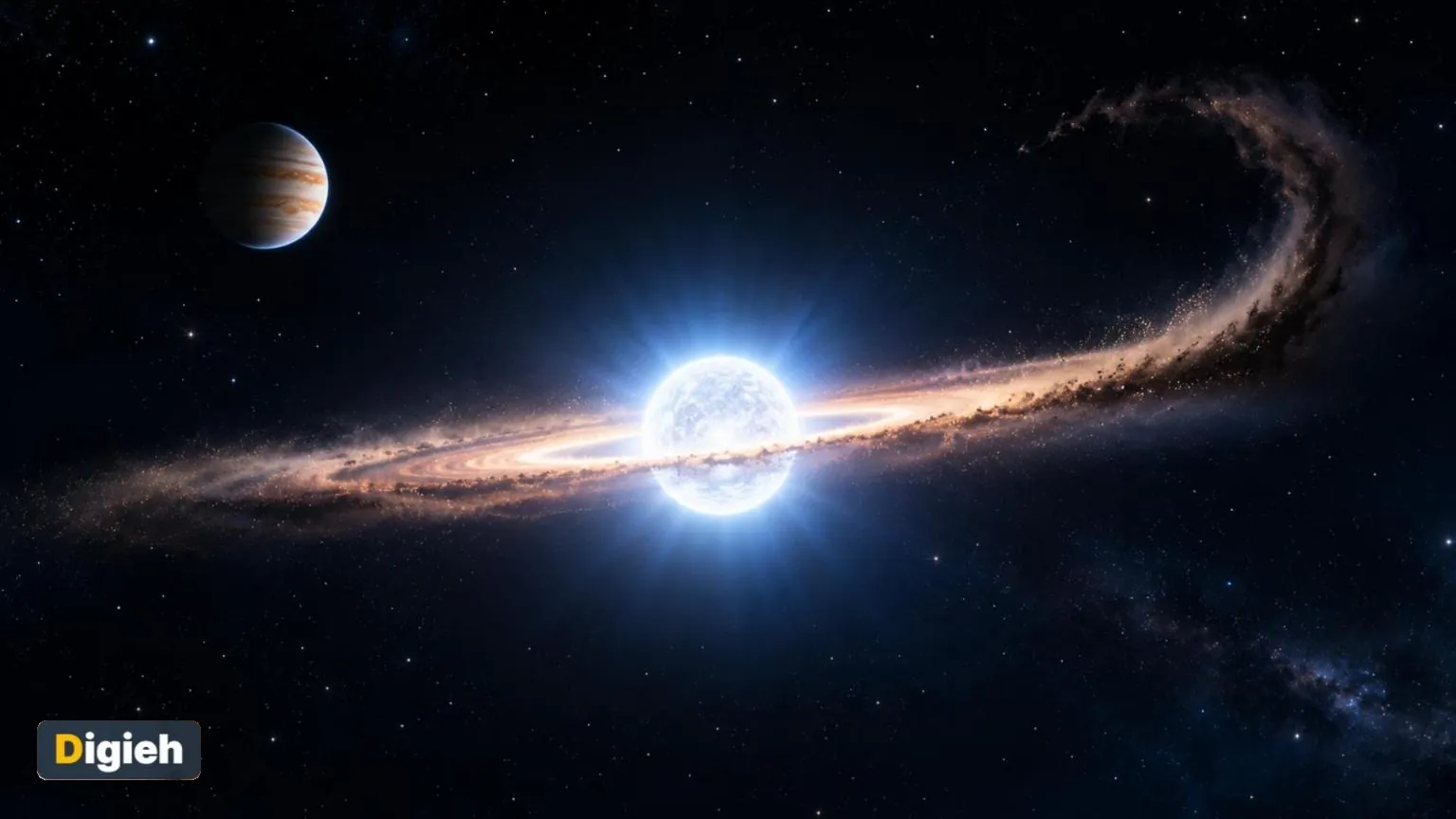
A dark streak near the star Beta Pictoris looks like a cat’s tail. New Hubble Space Telescope images suggest a giant crash between two small worlds made it.
Key Points
- The “cat’s tail” is so long it could wrap around the Sun and Earth about 500 times.
- It is likely debris from a collision between two Pluto-sized worlds.
- Hubble also found a warp in the tail, probably caused by a giant nearby planet.
What Is the Beta Pictoris Cat’s Tail?
Beta Pictoris is a young star about 63 light-years from Earth. It sits in the southern constellation Pictor, a name that means “the painter” in Latin.
A huge disk of dust and rocks surrounds the star. Astronomers call this a debris disk, and it shows how young planet systems grow.
James Webb Space Telescope (JWST) images from 2024 showed a thin curved feature at the edge of that disk. Its shape reminded scientists of a cat’s tail, according to the European Space Agency (ESA).
Good to know. A light-year is the distance light travels in one year, about 5.9 trillion miles.
What the New Hubble Study Found
A team led by Arin Avsar at the University of Arizona studied the tail with Hubble. They combined new pictures with images taken more than 14 years earlier, Space.com reported.
This was the first time anyone saw the tail in visible light. Webb had only seen it in infrared light, which human eyes cannot see.
The study appeared in The Astrophysical Journal Letters. It shows the tail is made almost entirely of dark, carbon-rich material that soaks up light.
500 timesHow many times the cat’s tail could wrap around the Sun and Earth, per Space.com.
Why the Tail Is So Dark and Fluffy
The dust grains in the tail are tiny and full of holes. Scientists describe them as very porous, almost fluffy.
Co-author Kevin Wagner offered one idea. The crash may have been fast enough to turn carbon grains into gas. That gas later cooled into airy new grains.
Avsar said the tail likely formed after two large bodies collided. He suggested people “think something like Pluto” when picturing those bodies.
Crashes like this were common when our own solar system was young. Some scientists think a similar crash formed Earth’s Moon.
Which space telescope amazes you more?
- Hubble
- James Webb
- Both equally
Free updates
Join the Digieh list
Be the first to know when our weekly brief launches.
No spam. Unsubscribe anytime. Read our Privacy Policy.
A Giant Planet Bends the Tail
Hubble also revealed a warp, or bend, in the tail. The team thinks a gas giant called Beta Pictoris b causes it.
That planet is about ten times as heavy as Jupiter. Its strong gravity can pull on dust and comets passing nearby. Avsar said this gives another clue about how giant planets shape comets.
You can see more Hubble discoveries on the National Aeronautics and Space Administration (NASA) Hubble mission page.
Beta Pictoris at a Glance
| Fact | Detail |
|---|---|
| Distance from Earth | About 63 light-years |
| Age of the star | No more than a few million years |
| Tail length | About 1,000 times the Earth-Sun distance |
| Likely cause | Crash between two Pluto-sized bodies |
| Nearby giant planet | Beta Pictoris b, about 10 times Jupiter’s mass |
Our Sun is about 4.6 billion years old. Planets around it formed long ago, so we cannot watch that process here anymore. That makes Beta Pictoris a baby, which is why it helps scientists learn how planets form.
Try this today. Open a free stargazing app tonight and search for the constellation Pictor to see where Beta Pictoris sits.
Frequently Asked Questions
Can I see Beta Pictoris from my backyard?
Yes, from southern parts of the world. The star is faint but visible without a telescope on dark nights.
Is the cat’s tail dangerous to Earth?
No. It is about 63 light-years away and poses no risk to our planet.
Why is it called a cat’s tail?
The curved shape of the dust looks like a cat’s tail flicking upward. For more space news, read about the Artemis II launch study. Also see what the end of daylight saving time means for night skies.
Found this useful?
Editor’s Note
This story is accurate as of November 7, 2026. It draws on research in The Astrophysical Journal Letters and reporting by Space.com.
Spot an error in this article? Please contact us at support@digieh.com or read our Corrections Policy.
Keep exploring
Your next read is waiting
 1Food & LifestyleHeartfelt Thanksgiving Messages to Send to Your Family9 min read
 2Finance & MarketsHSA Limits for 2027 and Smart Saving Tips9 min read
 3EntertainmentBest Thanksgiving Movies to Watch With the Family9 min read
 4TechnologyBest Time to See the Leonid Meteor Shower9 min read
 5NewsWinter Storm Watch vs Warning The Key Difference9 min read
 6HealthRhabdomyolysis Warning Signs That Every Person Should Know9 min read